What Every North Alabama Homeowner Needs to Know Before Building
Selling your Huntsville home can be a quick & easy process
So you are building a custom home in Huntsville. You have been thinking about the floor plan, the kitchen, the primary suite, the backyard. The exciting stuff.
Then your builder says — “So what foundation are you thinking? Slab or crawl space?”
And just like that, you are in a conversation you were not prepared for.
Most homeowners have never had to think about foundations before. Why would you? You live above them. You never see them. They just hold the house up.
But here in North Alabama, the foundation decision is one of the most important choices you will make about your new home. Not because you need to become an engineer. But because understanding the basics protects your investment, helps you ask the right questions, and makes sure the home you build performs the way you expect it to for decades to come.
Why Does This Matter More in North Alabama Than Anywhere Else?
The ground beneath Huntsville is not like the ground in most parts of the country. Our soil here is heavy with clay — and clay has one defining habit that causes real problems for homes built on top of it.
It swells when it rains. It shrinks when it dries out.
Think about what that means for your home. Every time it rains — and Huntsville gets a lot of rain, about 56 inches a year compared to the national average of 38 inches — the ground beneath your foundation quietly expands. Then summer hits, everything dries out, and the ground contracts again. Over and over. Season after season. Year after year.
That constant movement is what makes the foundation decision in North Alabama more consequential than almost anywhere else in the country. A foundation that performs perfectly well in a drier climate can develop serious, expensive problems here simply because the ground it is sitting on never truly stops moving
| What We Look At | North Alabama Reality |
| Huntsville annual rainfall | 56 inches |
| National average annual rainfall | 38 inches |
| Clay soil expansion potential | Up to 15% volume change |
| Primary risk to foundations | Differential movement from wet and dry cycles |
| Foundation cost as % of total build | 10% to 15% of total home cost |
This is not something to be alarmed about. It is something to be aware of — so you and your design-build team can make a decision that accounts for it from the very beginning.
What Is a Slab Foundation — And What Is Life Like in One?
Picture your home sitting directly on a thick, flat pad of reinforced concrete. That is a slab. There is no space between the bottom of your home and the ground. The concrete is both the foundation and your ground floor.
In everyday terms — it is the most straightforward foundation type. Less to build, less to maintain, and typically less expensive upfront than the alternatives.
What Slab Life Looks Like Day to Day
- You walk directly on the floor above concrete — solid and firm underfoot
- Your home sits low to the ground — easy access, great for single-level living
- No below-floor space to worry about or maintain
- Lower initial construction cost compared to a crawl space
What You Need to Know Before Choosing a Slab in Huntsville
The ground movement issue is real and specific to this region.
Because a slab sits directly on North Alabama’s clay soil, it is fully exposed to that swelling and shrinking cycle. Over time this can cause the slab to crack or shift in sections — which shows up as cracks in your walls, doors and windows that stick, and floors that feel slightly uneven. A properly engineered slab built specifically for North Alabama conditions manages this risk significantly — but it requires the right design from a builder who understands our local soil.
Your plumbing lives underneath the concrete.
This is the one that catches slab homeowners off guard years down the road. All the pipes that carry water through your home run beneath the slab. When everything works — great. But if a pipe develops a leak 15 or 20 years from now, accessing it means cutting through your concrete floor. That is a significant, expensive repair that crawl space homeowners simply do not face.
Your floors will feel the temperature of the ground.
Concrete conducts temperature — which means in a North Alabama winter your floors can feel cold underfoot. And in summer, ground moisture can work its way up through the slab if it is not properly sealed, leading to damp floors or musty smells over time.
| What We Look At | How Slab Performs in Huntsville |
| Upfront cost | ✅ Lower than crawl space |
| Works well on flat lots | ✅ Yes — ideal conditions |
| Works well on sloped lots | ❌ Costly to engineer |
| Clay soil movement risk | Moderate to high without post-tensioning |
| Plumbing repair cost down the road | High — requires breaking concrete |
| Moisture management needed | Moderate |
| Floor feel | Firm and solid underfoot |
| Ongoing maintenance | ✅ Very low |
What Is a Crawl Space Foundation — And What Is Life Like in One?
A crawl space foundation raises your home up off the ground. Instead of sitting directly on the earth, your home is built on perimeter walls — almost like a very shallow partial basement — with a gap between the ground and your floor. That gap is the crawl space. Usually about 18 to 36 inches of clearance.
In everyday terms — your home sits on a slight pedestal above the ground rather than directly on it.
What Crawl Space Life Looks Like Day to Day
- Your floors have a slightly warmer softer feel — wood floor system above the ground rather than concrete
- Your home sits slightly higher — a small step up at entry is typical
- All plumbing, electrical, and HVAC runs beneath the floor are fully accessible for inspection and repairs
- Heating and cooling tends to perform better — the floor is properly insulated above the crawl space
What You Need to Know Before Choosing a Crawl Space in Huntsville
Moisture is the number one enemy and North Alabama has plenty of it.
The space between your ground and your floor can trap humidity. In our climate — hot wet summers and heavy annual rainfall — an unmanaged crawl space can become a breeding ground for moisture, mold, and eventually wood rot in your floor structure. This is one of the most common problems we see in North Alabama homes.
Modern encapsulation solves this entirely but it is not optional here.
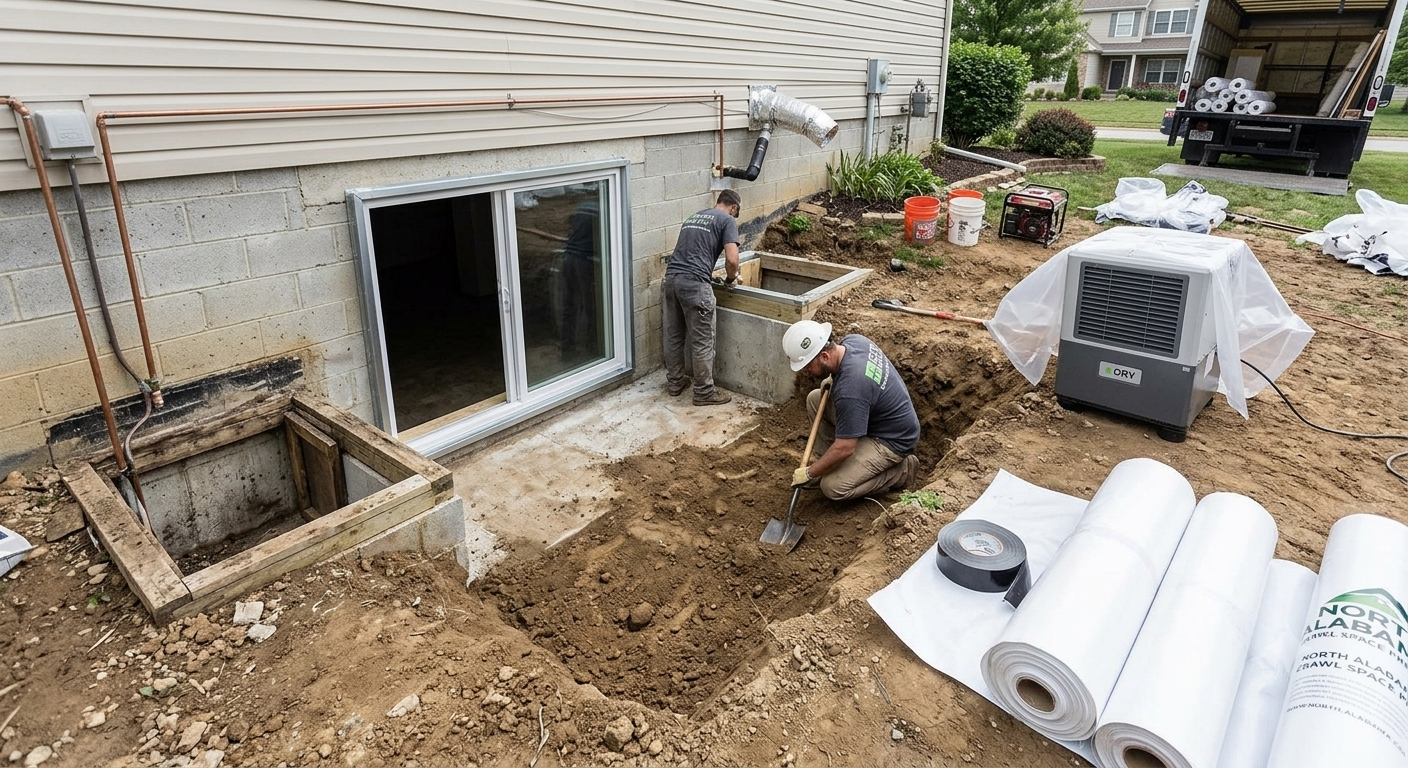
A properly encapsulated crawl space — where the ground and walls are sealed with a heavy-duty barrier and humidity is actively controlled — performs extremely well in North Alabama’s climate. Think of it as putting your crawl space inside a sealed climate-managed envelope. No moisture. No mold. No problems. It is an additional cost that the numbers below reflect — and in this climate it is a must-have not an upgrade.
Sloped lots are a natural fit for crawl spaces.
If your property has any significant grade to it — which many Huntsville lots do, especially in Hampton Cove, Jones Valley, and South Huntsville — a crawl space foundation is often the more practical and cost-effective choice. Engineering a level slab on a sloped lot gets expensive fast. A crawl space handles that grade change naturally.
| What We Look At | How Crawl Space Performs in Huntsville |
| Upfront cost | ⚠️ Higher than slab |
| Works well on flat lots | ✅ Yes — performs well |
| Works well on sloped lots | ✅ Excellent — natural fit for North Alabama grades |
| Clay soil movement risk | ✅ Lower — structure elevated above soil movement |
| Plumbing repair cost down the road | ✅ Low — fully accessible below the floor |
| Moisture management needed | ❌ High — full encapsulation required in this climate |
| Floor feel | Warm and slightly flexible underfoot |
| Ongoing maintenance | ⚠️ Periodic inspection recommended |
Side by Side — Slab vs. Crawl Space in North Alabama
| What We Look At | Slab | Crawl Space |
| Upfront cost | ✅ Lower | ⚠️ Higher |
| Flat lot performance | ✅ Good | ✅ Good |
| Sloped lot performance | ❌ Costly | ✅ Excellent |
| Clay soil movement risk | ⚠️ Higher | ✅ Lower |
| Future plumbing repair cost | ❌ High | ✅ Low |
| Moisture management | ⚠️ Moderate | ❌ Encapsulation required |
| Floor feel | Firm — concrete | Warm — wood system |
| Pest and rodent risk | ✅ Low | ⚠️ Moderate — requires sealing |
| Ongoing maintenance | ✅ Very low | ⚠️ Periodic inspection |
| Best suited for | Flat lots, simpler builds | Sloped lots, larger homes |
The Three Questions That Point You to the Right Answer
You do not need a geology degree for this. Three honest questions will point you in the right direction:
Question 1: What does your lot look like?
| What We Look At | How It Points Your Foundation Decision |
|---|---|
| Flat lot with good drainage | Slab is a strong and cost-effective option |
| Slightly sloped lot | Either can work — a site assessment will clarify |
| Significantly sloped lot | Crawl space is almost always the right call |
| Heavy clay soil confirmed | Crawl space with full encapsulation |
Question 2: How long are you planning to live there?
| What We Look At | How It Points Your Foundation Decision |
|---|---|
| 5 to 10 year horizon | Slab may be the more cost-effective choice |
| 10 to 20 year horizon | Both work — plumbing access starts to matter more |
| Forever home | Crawl space access advantage becomes very significant |
| Resale focused build | Either works — lot conditions drive the decision |
Question 3: What is your tolerance for future maintenance?
| What We Look At | How It Points Your Foundation Decision |
|---|---|
| Set it and forget it | Slab on a well-prepared flat lot |
| Happy to do annual checks | Crawl space with full encapsulation |
| Want easy access to everything below | Crawl space — hands down |
| Never want to think about it again | Slab — very low ongoing maintenance |
Warning Signs to Know — For Both Foundation Types
Every foundation type has its own set of things to watch for as your home ages. Here is a side by side look at what each one tells you:
| What We Look At | Slab Warning Sign | Crawl Space Warning Sign |
|---|---|---|
| Cracks appearing | Cracks in walls or ceilings — clay soil shifting beneath the slab | Soft or springy spots in flooring — wood rot beginning in floor structure |
| Doors and windows | Suddenly sticking or difficult to open — foundation shifting beneath | Harder to seal against drafts — frame movement from moisture below |
| Smell inside the home | Musty odor in carpeted rooms — moisture migrating up through concrete | Musty smell rising from floors — moisture buildup in crawl space |
| Floor performance | Uneven or sloping floors — differential movement beneath the slab | Higher indoor humidity than usual — crawl space moisture migrating upward |
| Utility and water bills | Unexplained spike in water bill — possible pipe leak trapped under concrete | Higher energy bills — encapsulation failure letting in outside air |
| Visible damage | Surface cracks in the slab itself — especially near corners and doorways | Condensation visible on floor joists — dehumidifier not performing |
| Pest activity | Gaps forming at base of walls — soil movement creating entry points | Rodent or pest activity near foundation — access points not properly sealed |
Catching any of these signs early saves you significantly on repair costs. Neither foundation type is maintenance-free — but knowing what to look for puts you in control before a small issue becomes a big one.
What Does This Actually Cost in Huntsville in 2026?
Foundation work is not cheap — and in North Alabama it costs more than most online estimates suggest. Here is a realistic snapshot:
| What We Look At | How It Breaks Down in Huntsville 2026 |
|---|---|
| Standard slab — flat lot | $12,000 — $28,000 |
| Post-tensioned slab — clay soil | $20,000 — $35,000 |
| Standard crawl space | $25,000 — $45,000 |
| Crawl space with full encapsulation | $30,000 — $60,000 |
| Walk-out basement | $50,000 — $100,000+ |
| Foundation as % of total build cost | 10% to 15% of your total project |
Your actual cost depends entirely on your lot, your soil conditions, and your home’s footprint. The only number that matters is the one built around your specific property— and that is exactly what we provide during your free pre-construction consultation.
A Quick Word on Basements in North Alabama
Full basements are rare here — and there is a reason for that. North Alabama’s clay soil pressure, high water table across much of Madison County, and our annual rainfall levels make a fully below-grade basement a complex and expensive waterproofing challenge.
Walk-out basements on sloped lots are a different story entirely — additional livable square footage, natural light on the lower level, and a foundation that works with your lot’s grade rather than against it.
| What We Look At | How It Applies to Basements in North Alabama |
|---|---|
| Lot has significant natural slope | ✅ Strong candidate for a walk-out basement |
| Want additional finished living space | ✅ High value add to your home |
| Budget allows $50,000 — $100,000+ | ✅ Worth a serious conversation |
| Flat lot with no grade change | ❌ Walk-out basement not practical |
| Tight construction budget | ❌ Slab or crawl space is the smarter path |
Not sure if your lot qualifies? Raise it early in your builder conversation — before any other design decision gets made.
The One Thing That Matters More Than Foundation Type
The foundation type matters less than how well it is designed and built for your specific lot. A slab built correctly for North Alabama conditions will outlast a crawl space built with shortcuts. And a properly encapsulated crawl space on the right lot will outperform a slab that was not engineered for clay soil movement.
| What We Look At | How It Affects Your Foundation’s Long-Term Performance |
|---|---|
| Soil test before design begins | Tells your builder what is actually beneath your lot — not an assumption |
| Builder with genuine local experience | North Alabama clay behaves differently — local knowledge is not optional |
| Proper site drainage from day one | The leading cause of foundation problems is water with nowhere to go |
| Right moisture management system | Vapor barrier under a slab — full encapsulation in a crawl space |
If your builder is not talking about soil testing and site drainage before they talk about floor plans — that is worth asking about.
Your Most Common Questions | Answered Plainly
Is crawl space encapsulation really necessary in Huntsville — or is it just an upsell?
Genuinely necessary — not an upsell. Unencapsulated crawl spaces in North Alabama consistently develop moisture, mold, and wood rot problems that cost significantly more to fix than encapsulation would have cost at the time of construction. In this climate it is the baseline not the premium option. See how we approach crawl space encapsulation in Huntsville →
My neighbor’s slab cracked after five years. Should I be worried?
Ask why it cracked. Slab cracking in North Alabama is almost always the result of inadequate soil preparation or a conventional slab design on conditions that required post-tensioning. The problem is not slabs — it is slabs built without accounting for our specific soil conditions. It is exactly the kind of conversation worth having with your builder before you commit to a foundation type.
Can I change my foundation type after I have already bought my lot?
Yes — foundation type is a pre-construction decision not locked in by the lot. A soil investigation is always the right first step after purchase. We walk you through exactly that during your free pre-construction consultation at Redstone Ridge.
Selling your Huntsville home can be a quick & easy process
How Redstone Ridge Homes Handles the Foundation Decision
We do not have a preferred foundation type. We have a preferred process — and it starts with your specific lot not a spec sheet. Every custom home we build across Huntsville, Madison, Hampton Cove, Harvest, and the broader Tennessee Valley begins with a site assessment that evaluates your soil conditions, drainage characteristics, slope, and water table. That assessment drives the foundation recommendation — not a default setting applied to every project.
We specify post-tensioned slabs where the site calls for it. We specify fully encapsulated crawl space systems on every crawl space build — because we know what an unencapsulated crawl space looks like in five years in this climate. And we never cut the foundation budget to hit a number at the expense of long-term structural performance.
Your foundation is the one part of your home you will never see after construction is complete. It is also the one part that affects everything above it for as long as your home stands. We treat it that way on every single project.
Ready to Talk About Your Huntsville Home’s Foundation?
If you are planning a custom home anywhere across Huntsville, Madison, Hampton Cove, Harvest, or North Alabama — the foundation conversation is one we want to have with you before anything else. Before you finalize a lot. Before you commit to a floor plan. Before any design decision locks in a foundation approach that may not be right for your specific site.
That conversation is free. It is honest. And it could save you from one of the most expensive mistakes a North Alabama homeowner can make.
Call 256-216-4580 or schedule your free pre-construction consultation in Huntsville, Alabama today.
Your Dream. Our Blueprint.