
Building a custom home should feel exciting — and most of it is. But if you’ve talked to anyone who’s been through it recently, you’ve probably heard at least one story about a permit delay, a subcontractor who didn’t show, or a budget that crept up faster than expected. None of that is inevitable. It’s just what happens when the real challenges of building here in 2026 aren’t dealt with head-on.


So let’s deal with them head-on. Here are the seven problems we see most often with custom builds in Madison County right now, why they’re happening, and exactly what keeps each one from becoming your problem.

The 7 Biggest Problems Building a Custom Home
Permit and Inspection Delays
Huntsville is growing fast enough that its permitting offices are feeling the strain right along with everything else. Standard residential plan reviews through Huntsville Building Services typically take 5 to 15 business days, and many projects need sign-off from multiple departments — Planning, Zoning, Engineering, Inspection, and sometimes Natural Resources — before you’re cleared to build. If your lot sits in a FEMA Special Flood Hazard Area, add a Flood Development Permit to that list before anything else can move forward.
Madison County, meanwhile, enforces its own residential construction code with local amendments, and inspections have to be requested by 2 PM the business day before you need them miss that window, and your inspection slides to the next available slot, which can cost you real days on a tight schedule.
How to avoid it: submit a complete application the first time. Incomplete site plans, missing sewer/septic approval letters, or missing address assignments are the most common reasons a review gets kicked back — and every kickback restarts the clock. A builder who handles this daily knows exactly what Madison County and Huntsville reviewers want to see before it ever gets submitted. At Redstone Ridge Homes, we handle the entire permitting process on your behalf — so you’re not the one tracking down a missing document or resubmitting a kicked-back application while your timeline slips.
Material Cost Volatility (Especially Metals and Finishes)
The material cost story in 2026 is more complicated than “everything’s expensive.” Framing lumber has actually been relatively stable — sitting around $870–$915 per thousand board feet, well below its 2021 peak — but metals are a different story entirely. Tariffs on imported steel, aluminum, and copper have pushed nonresidential construction input prices up at a 12.6% annualized rate in early 2026, and metal trim and molding specifically have surged nearly 50% year-over-year. Copper, driven by demand from data centers and electrical infrastructure nationwide, remains especially tight.
The practical effect: the parts of your home that use a lot of metal — HVAC systems, electrical components, certain trim and hardware, appliances — are more exposed to price swings than framing lumber is.
How to avoid it: lock in your finish selections and major system specs as early as possible, and ask your builder whether your contract includes any price-escalation protection on long-lead materials. Early buyout of metal-heavy items (HVAC equipment, electrical gear, appliance packages) is one of the few real levers to protect your budget from mid-build price jumps. For a full breakdown of how hard costs, soft costs, and hidden costs fit together, see our complete guide to custom home building costs in Madison County.
Unclear Allowances and Budget Creep
Even once site costs are accounted for, the interior of the house has its own way of quietly exceeding budget — usually through allowances. An allowance is a placeholder dollar figure for something you haven’t picked out yet, and it’s easy to blow past it once you’re standing in a showroom looking at a countertop, a lighting fixture, or a cabinet upgrade that’s genuinely beautiful and genuinely over budget.
How to avoid it: ask for a full, written, line-item allowance breakdown — flooring, countertops, cabinetry, plumbing fixtures, lighting, appliances — before you sign anything, and ask to see real product examples at your allowance level, not just a number on a page. Seeing an actual quartz slab or light fixture at your price point does more to prevent sticker shock than any spreadsheet can. We break down exactly what to ask for, by category, in our guide to builder allowances and where budgets actually go.
Skilled Labor Shortages Pushing Out Your Timeline
This one isn’t specific to us — it’s a national story right now — but it’s landing hard in fast-growing markets like Huntsville. Alabama’s construction workforce is aging, with the average worker now 43 years old, and industry data shows that for every five tradespeople who retire, only one is being trained to replace them. Nationally, the industry needs roughly half a million additional skilled workers in 2026 just to keep pace with demand — and Huntsville added close to 5,000 new housing units in 2025 alone, which means local demand for electricians, plumbers, and HVAC techs isn’t slowing down anytime soon.
What this means in practice: builders without strong, established subcontractor relationships are increasingly stuck waiting in line — and that wait shows up as schedule slippage on your build.
How to avoid it: ask a prospective builder how long they’ve worked with their electrical, plumbing, and HVAC subs. Long-standing relationships mean your project gets prioritized instead of squeezed in around bigger commercial jobs. It’s one of the simplest questions that tells you the most.
Red Clay, Expansive Soil, and Foundation Problems
If you’ve ever tried to dig a hole in a North Alabama yard, you already know this soil fights back. Much of Madison County sits on clay-heavy soil that engineers call “expansive” — it swells when it absorbs water in wet seasons and shrinks again during our hot, dry summers. That shrink-swell cycle is the single most common cause of foundation movement in this region, and it doesn’t announce itself right away — it shows up years later as cracked brick, doors that stop latching, or slabs that settle unevenly.
This isn’t a rare, unlucky-lot problem. It’s the baseline condition across much of North Alabama, with limestone bedrock affecting drainage in parts of Madison County and heavier clay elsewhere shifting the specifics lot to lot.
How to avoid it: this comes down to two things done right, before you ever pour concrete — a proper geotechnical soil evaluation, and grading/drainage designed specifically for your site’s soil behavior, not a generic plan copied from a flatter or sandier lot. Getting this right at the foundation stage is dramatically cheaper than fixing shrink-swell damage after move-in.
Land and Site Surprises That Weren’t in the Budget
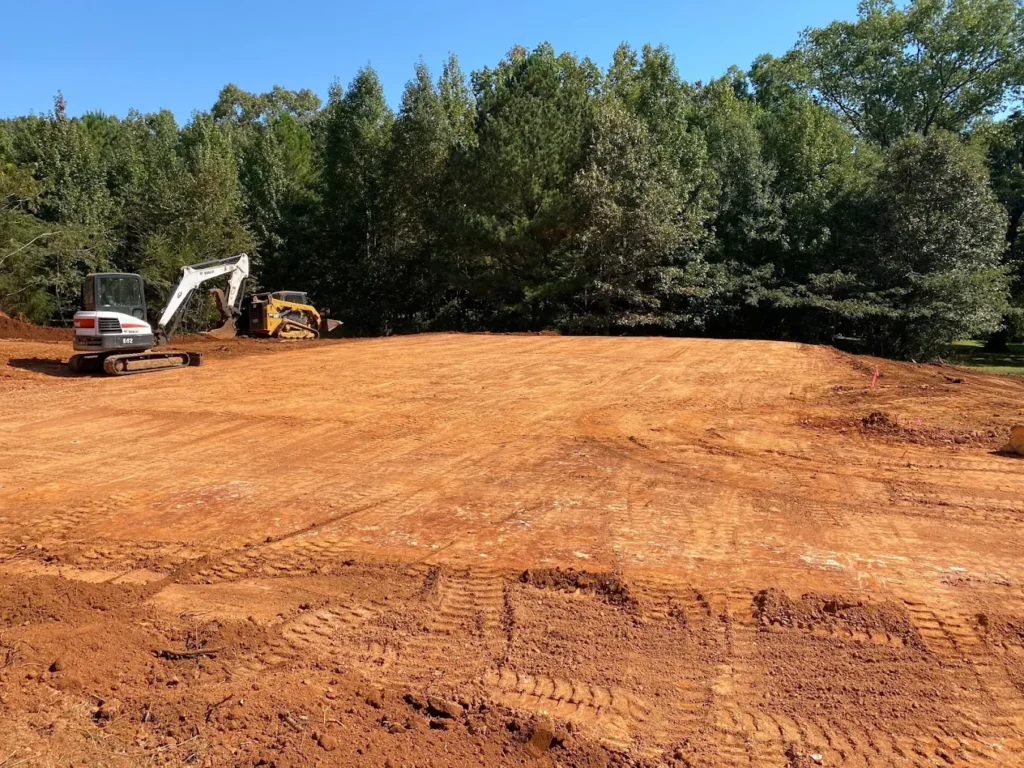
We see this constantly: a buyer falls in love with a lot, gets a build quote based on the house alone, and only later discovers what the land is going to cost to actually build on. Sloped lots need grading. Lots without municipal sewer need septic — and septic systems on Madison County’s clay-heavy or rocky soil often require a more expensive engineered system rather than a standard gravity-fed one. Wooded lots need selective clearing. Rural lots need longer utility runs. None of this shows up in a generic “$/sq ft” estimate.
How to avoid it: get your site evaluated — soil, slope, septic feasibility, utility distance — before you finalize your budget, not after you’ve already fallen in love with the lot. A realistic site-work number, even if it’s a range, prevents the single most common source of “surprise” costs we see buyers run into. If you’re building on a sloped or wooded lot, our guide on what to expect during site excavation and land clearing walks through exactly what that process looks like, and our cost breakdown covers land and site-work pricing in more detail.
Choosing a Builder Based on Price Alone
This is the problem that tends to cause every other problem on this list. The lowest quote often looks the most attractive on paper — until it turns out to exclude the driveway, use a thinner allowance on every finish, or come from a builder who’s stretched thin across too many jobs to give yours the attention it needs. By the time that becomes clear, you’re already under contract.
How to avoid it: compare full, written scopes of work — not just bottom-line numbers. Ask how long a builder has worked in Madison County specifically, how they handle change orders, and how they communicate during the build. A builder who’s upfront about real costs, real timelines, and real trade-offs from the first conversation is a much stronger signal than the lowest number on a page.
The Common Thread
Almost every problem on this list comes down to the same root cause: information you didn’t have early enough. Permit requirements you didn’t know applied to your lot. Soil conditions no one tested. An allowance that looked fine on paper but not in the showroom. The fix, in nearly every case, is the same — get the real numbers, the real site evaluation, and the real scope of work before you’re locked into a contract, not after.
Build With a Team That Deals With All of This Every Day
At Redstone Ridge Homes, we’ve built in Madison County long enough to know exactly where these seven problems tend to show up — and we build our process specifically to catch them before they become your problem. From site evaluation to permitting to a written allowance breakdown before you ever sign, our goal is a build with no surprises waiting for you six months in.
Contact Redstone Ridge Homes for a free consultation, and let’s talk through what your specific lot and plan actually need.